
A hypothesis about Erving Goffman
Or how Simone de Beauvoir ended up in Chicago sociology (maybe)

Erving Goffman’s The Presentation of the Self in Everyday Life is one of the postwar classics of in all of social science. At the time of writing it has almost reached 100,000 citations on Google Scholar. The book famously uses theatrical metaphors to talk about micro-interactions in social life, drawing attention to how much of human interaction is a performance. Perhaps the most memorable set of concepts that Goffman has provided is that of the front-stage and back-stage: what do we let others see, and what do we hide from them. (And more importantly for Chicago (Meadian) sociology how do we construct a ‘self’).
But I don’t want to talk about big ideas here. Instead, I want to throw out a speculation about the origins of the rather frequent and substantive references to Simone de Beauvoir in Goffman’s classic. As far as I know there is no secondary literature on the reason that De Beauvoir’s Second Sex is quoted so frequently. My own (limited) search resulted in a blogger in 2009 speculating on the general popularity of existentialism in the 1950s, and that was all. This recent book which is meant to cover Goffman’s ‘biographical sources of sociological imagination’ is silent on the matter.
My suggestion is simple. Simone de Beauvoir frequented Chicago during the time that Goffman studied there. She was having a passionate affair with Chicago novelist (maybe the best?) Nelson Algren. The juiciest bit of evidence of the affair is this nude picture of Simone, taken by Art Shay who has an amazing photo book about Algren’s Chicago. The affair of Algren and De Beauvoir lasted from 1947 to 1950, at which point Nelson wanted more commitment, while Simone was unwilling to give up her relations to Sartre and France. But during the late 40s De Beauvoir was in Chicago frequently, already working on her own (future) classic The Second Sex. She would also publish a thinly-veiled novel about the affair with Algren, 1954’s The Mandarins.
Algren’s favorite activity with De Beauvoir was slumming. They went to the bars, police line-ups, and flophouses that Algren used as places of observation for his novels. De Beauvoir’s own observations about Chicago appear to reflect this experience of the somewhat uppity French intellectual strolling through the backstreets of the Windy City with Nelson:
In the evenings especially, a provincial poetry floats through the streets. At the corner of a dead-end street, children smoke and whisper about their plans. Sitting on their porches, women watch the city lights on the horizon. The groaning of the El shakes the silence; the foliage of a tree rustles; a cat rummages in a trash can: the slightest sound lingers. You feel far, far away from human ventures and follies, in the heart of a calmly ordered life that repeats itself day after day. Yet tomorrow morning you’ll read in the paper that they found a corpse cut into pieces in one of these alleys, that two men slit each other’s throats in a nearby bar, that a barkeeper was shot down with a revolver two steps away. The sweetness of Chicago nights is deceptive.
But back to Goffman. His use of De Beauvoir is very stimulating. His first and last reference to her work (both long block quotes) draw attention to the way that women’s dress and make-up stabilize the presentation of the self. The second reference which again is accompanied by a lengthy block quote talks about the different forms of interaction between men and women on the one hand, and women among themselves on the other. When among each other there is a sense of solidarity that Goffman considers to be an essential feature of back-stage settings. It can, for instance, also be found among waiting staff gossiping in the kitchen about the guests they are serving. His third long block quote citation of De Beauvoir is a full three paragraphs long and includes this observation:
“Collectively they [women] find strength to shake off their chains; they negate the sexual domination of the males by admitting their frigidity to one another, while deriding the men’s desires or their clumsiness; and they question ironically the moral and intellectual superiority of their husbands, and of men in general.”
One other sensibility in Goffman’s book, that I would attribute to De Beauvoir’s influence, is that he recognizes that various social situations demand of women and girls that they play dumb or ignorant. The basic dynamic of hiding one’s opinions is of course broader, there are many social occasions when we hide or mask our taste or views to avoid awkwardness. But it is striking that in Goffman’s work there is relatively much attention to the female experience. And he is very straightforward about the matter:
American college girls did, and no doubt do, play down their intelligence, skills, and determinativeness when in the presence of datable boys, thereby manifesting a profound psychic discipline in spite of their international reputation for flightiness. These performers are reported to allow their boy friends to explain things to them tediously that they already know; they conceal proficiency in mathematics from their less able consorts; they lose ping-pong games just before the ending.”
I don’t think we’re going to find a better definition of mansplaining in recent discourse. (Okay, okay, I get the irony of a man ’splaining what mansplaining is).
One of the major themes I will write about in my Chicago book is the affinity for underdogs, and marginalized perspectives among Chicago writers and thinkers. But I have to admit that there is frequently a relative neglect of women perspectives’ in both the Chicago novels and Chicago sociology. But let’s at least stop overlooking the great sociological monograph The Saleslady. And I think it is safe to say that Erving Goffman’s Presentation of the Self is another wonderful exception.
And here at the end I have to stress that I have no shred of concrete evidence that Goffman met De Beauvoir in Chicago, or even that he was acquainted with Nelson Algren. I only have the speculation that De Beauvoir’s frequent visits probably meant that her ideas and name circulated in Chicago circles, and that they attracted the attention of a young sociologist working on his Ph.D.[1] That, and the very circumstantial evidence that Algren, Goffman, and De Beauvoir all wrote about what Goffman would later call ‘total institutions’: prisons, mental hospitals, gender roles(?). And they all explored how individuals nonetheless find ways to cope and deal subversively with these systems aimed at total control, if not front-stage, then at least back-stage.
[1] I checked and there are no references to De Beauvoir in his 1953 thesis ‘Communication Conduct in an Island Community.’
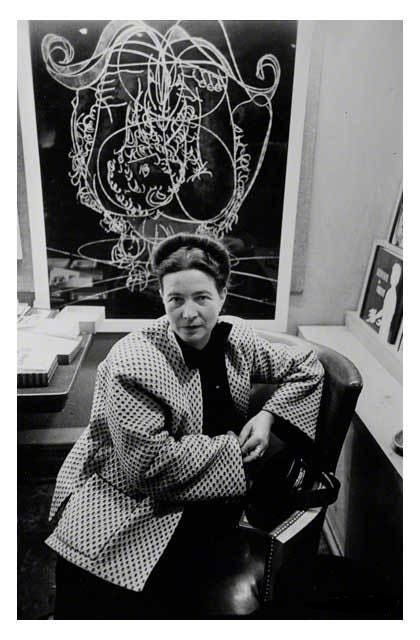
Simone de Beauvoir in Chicago in 1950. Photo: Art Shay