
William I. "Controversy" Thomas
Women’s rights, academic freedom, and a career cut short

William I. Thomas is primarily known as the author of classic The Polish Peasant in Europe and America, co-authored with Florian Znaniecki, a book which is often considered the major inspiration, or the first achievement, of the Chicago School of Sociology. Thomas’ academic career was cut short by a sexual scandal that cost him his job. The details of the scandal are still not quite clear, judging by the more recent histories of the Chicago School of Sociology. What is clear, is that Thomas was arrested under the Mann Act (a law adopted to combat white slavery) at Hotel Breveert in 1918, where he was suspected of having sex with a woman whose husband was fighting overseas in the American army. He was quickly dismissed from the University, although he was ultimately acquitted from the charges.
There is speculation that Thomas’ arrest was motivated by the fact that his wife Harriet was a vocal pacifist and opponent of America’s involvement in the War. An activity that earned fellow women activist Jane Addams the label of ‘most dangerous woman in America.’ Other speculations have suggested that Thomas own progressive ideas (not Progressive, they were much more prudish) about sex were the ulterior motive.
I was therefore quite excited when I found letters by Thomas in the archive of Morris Janowitz in which Thomas defended himself in a scandal to his colleague Albion Small. I, however, soon found out that this scandal happened a few years earlier in 1915, when a lecture Thomas had given to the Women’s Equal Suffrage Association had given rise to a public outcry in the newspapers. Yet, it turned out that his defense in these three letters provide a fascinating glimpse into Thomas’ views of academic freedom, and the role of the social scientist in society as they are expressed to his colleague Small, who acted as an intermediary between Thomas and the Board of the University.
In his lecture Thomas had made two claims that had upset part of his audience, first he had argued that there was no such thing as an illegitimate child, or more precisely that it was wrong to shame women who deliberately chose to have children outside of marriage. And second he had argued that women deserved access to information about birth control, especially if they already had a couple of children. In hindsight, he was clearly arguing that women should have agency over their choice whether, when, and how often to have children.
But the letters are not primarily about the substance of his arguments. Thomas realized that his views were controversial, instead he suggests the matter is about:
What is the nature of a University? Is it entirely esoteric, or can its members communicate frankly with the public? Shall the University man associate himself with public movements or shall he not? Shall he before the public and before his classes be guarded and confine himself to the expression of accepted traditions? Is the University as a whole or are its members to stand for all the sentiments and opinions of one of its members, or is the University a place where various opinions are held and expressed?
Although this framing of the questions is clearly favorable to Thomas own point of view, he shows awareness of his position in the academic community. He for instance refers to a scandal about a decade earlier about a book of his, and the fact that many of his colleagues believe that it is only a matter of time before Thomas finds himself in another scandal. The earlier scandal he refers to what most likely about his book Sex and Society (1907), which is a somewhat Freudian discussion of the evolution of the role of sex and sexual morality in society.[1]
Thomas also does not seek to evade responsibility for his actions. He endorsed the views attributed to him by the press, and suggested he has a responsibility toward his audience, to not surprise or unnecessarily provoke. He even suggested that controversial matters are best discussed between academics and ‘the more advanced members of the public.’ (After which he argues that the Women’s Equal Suffrage Assocation is such a group). But he also believes that academics have a role to break taboos and to push public opinion forward:
There is nothing in which I am more interested than the rate at which social change can take place without distingration of character. You will, of course, agree with me that the matter turns largely, in moral questions, on the preparedness of society at a given moment. But you many not agree with me that we are inclined to exaggerate and be over-anxious about the demoralizing effect of new ideas suddenly introduced.
In other words, he regards himself like something of a moral elite, who with other ‘advanced’ members of society can help bring about social change by pushing public opinion forward. This is an essential part of the American Progressive mindset. What Thomas unfortunately does not address much is that his views on the direction of social change appear at odds with quite a few of the Progressive moral reformers, who quite often wanted to strengthen older traditions and moral norms. (As he observes: ‘our reform efforts are so futile largely because we insist in embodying tin them our older traditions without attempting to create new traditions or taking advantage of the newer ones as they come into existence.’ ‘Our efforts’ clearly suggests he saw his own activities as part of the Progressive reform movement.)
But the most fascinating concept in Thomas’ letter is the concept of ‘a universe of discourse.’[2] Throughout he sees himself as contributing to this universe, and his defense depends not on whether he has the right to state his views frankly, but whether his views are broadly within this universe of discourse. In his letters he suggests that his views are indeed held by some others, and that at least some in his audience were receptive to it. The universe of discourse is also how he evaluates his lecture in relation to his audience, a group of progressive women. Finally, there is a theory of how a discourse progresses, or simply changes, and here he adopts an explicitly optimistic point of view, in contrast to those who are ‘over-anxious’ about the demoralizing effects of new ideas.
In other words, Thomas is not at all putting up an absolutist, or principled argument for academic freedom. Instead, he thinks of academics and the public as being in a conversation (discourse) with each other, and this relationship must be maintained, by academics considering the currents within public opinion, as well as the expected effects of the views they express. In this way, he also answers the question about the association with public movements. The academic does not have to side with them; he can treat them instead as particularly good and relevant conversation partners.
These views are of interest to me because Thomas writes at the end of the Progressive era and is very important for the more radically egalitarian (democratic) sociology of the Park generation and even the critical stance of later Chicago sociologists like Howard Becker, who explicitly sides with the underdog. Thomas remains a Progressive at heart, with his more elitist view of pushing public opinion forward but already takes ‘the public’ very serious, as partner rather than as object of manipulation or control.
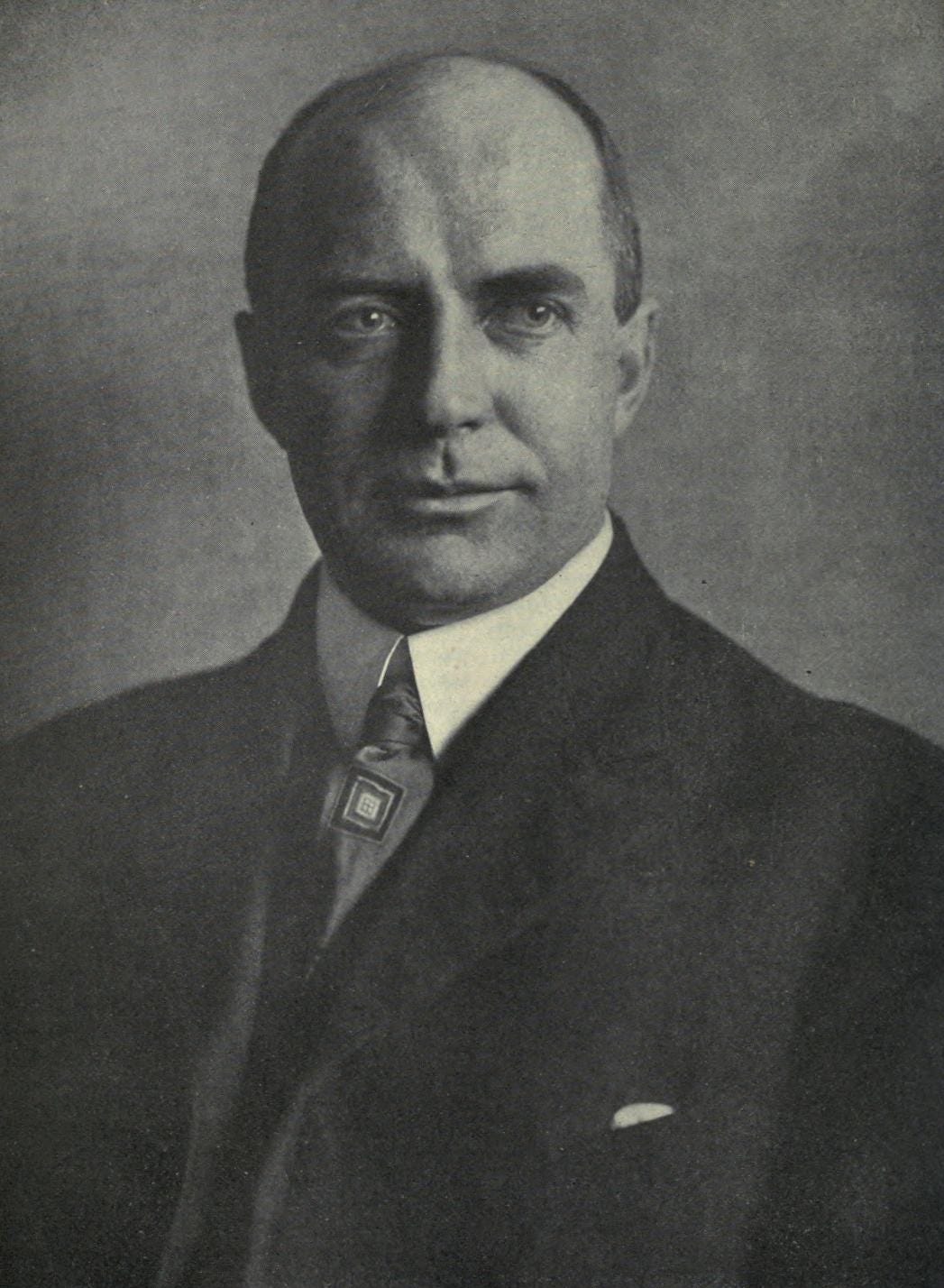
William I. Thomas around 1906, image in the public domain, https://commons.wikimedia.org/wiki/File:Portrait_of_William_Isaac_Thomas.jpg
[1] He also refers to future planned work on prostitution which he expects to be controversial.
[2] I did not look into the history of the concept, but I would be very interested in pointers about the origins of it.